August 23, 2016—
Developing the UN Commission of Inquiry on Human Rights in North Korea Report... The United Nations Human Rights Council established the Commission of Inquiry (COI) on Human Rights in the Democratic People’s Republic of Korea (DPRK) on March 21, 2013. The mission of the Commission was to investigate…
August 18, 2016—
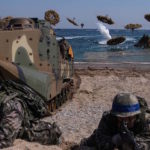
A new study by Beyond Parallel shows that annual US-ROK military exercises do not provoke North Korea... A Beyond Parallel study showsthat annual U.S.-South Korea military exercises – such as Ulchi Freedom Guardian which commence next week – do not provoke North Korea. The study’s findings demonstrate that these summer/fall exercises, like…
August 17, 2016—
Thae Yong-ho, a minister in the DPRK embassy in London, UK, has defected with his wife and son to South Korea and is currently under the protection of the government pending the formal procedures to process their entry into the country... Thae Yong-ho, a minister in the DPRK embassy in London, UK, has defected with his…
August 7, 2016—
CSIS Beyond Parallel datasets offer…
May 27, 2016—
The 1994 Agreed Framework was the result of negotiations between the United States and the Democratic People’s Republic of Korea (DPRK) over the course of nearly two years. Signed on October 21, 1994, the goal of the agreement was to freeze North Korea’s suspected nuclear weapons program.
May 27, 2016—
To critically test this proposition, Beyond Parallel gathered data on the relationship between the United States-Republic of Korea (ROK) military exercises and North Korean provocations. The scope of our qualitative study was the past 12 years of annual U.S.-ROK spring military exercises (2005–2016).
April 22, 2016—
Dandong, China, remains the epicenter of cross-border economic transactions between China and North Korea, where regular boat, railway, and road traffic is witnessed... Dandong, China, remains the epicenter of cross-border economic transactions between China and North Korea, where…
April 8, 2016—
A survey study of 233 of the United States’ top Asia/Korea experts, government officials, scholars, and opinion leaders found that domestic stabilization, not nuclear weapons, ranks as the #1 issue for the U.S. with unification (i.e., highest composite score in the entire survey in terms of most acute lack of knowledge/most acute concern for U.S. interests). The top four blind spots for the U.S.: 1) domestic stabilization; 2) nuclear weapons; 3) economic development; 4) cost.