
China Begins Relocating Structure from PMZ
Key Findings
- CSIS imagery analysis and AIS data collection finds that China has begun relocating the Atlantic Amsterdam from inside the Provisional Measures Zone (PMZ) on January 27.
- Our analysis finds the platform under tow by the De Hong, a Chinese tugboat broadcasting AIS signals and moving north towards the PMZ boundary with the ultimate destination as yet unknown.
- Beijing and Seoul have confirmed the platform’s movement, as agreed to at the recent summit meeting between the two leaders.
- While the relocation of the Atlantic Amsterdam may help ease immediate tensions, the two aquaculture cages, Shen Lan 1 and Shen Lan 2, remain in place. How China manages these remaining structures will shape whether the relocation of the Atlantic Amsterdam reflects a limited response to South Korea’s most pressing concerns or the beginning of a broader effort to promote stability in the area.
- The Atlantic Amsterdam is a maritime management platform, converted by China from an oil platform, complete with helipad that was unilaterally positioned by China inside the PMZ in contravention of a mutual consultation agreement with South Korea.
Earlier on January 27, the South Korean and Chinese governments confirmed that China would relocate the Atlantic Amsterdam, a maritime management platform located within the Provisional Measures Zone, later that day. South Korean officials added that the structure was being moved “out of the PMZ and toward Chinese land,” and that the decision to do so “reflected both sides’ natural consensus’ that the management structure was the most sensitive.”1
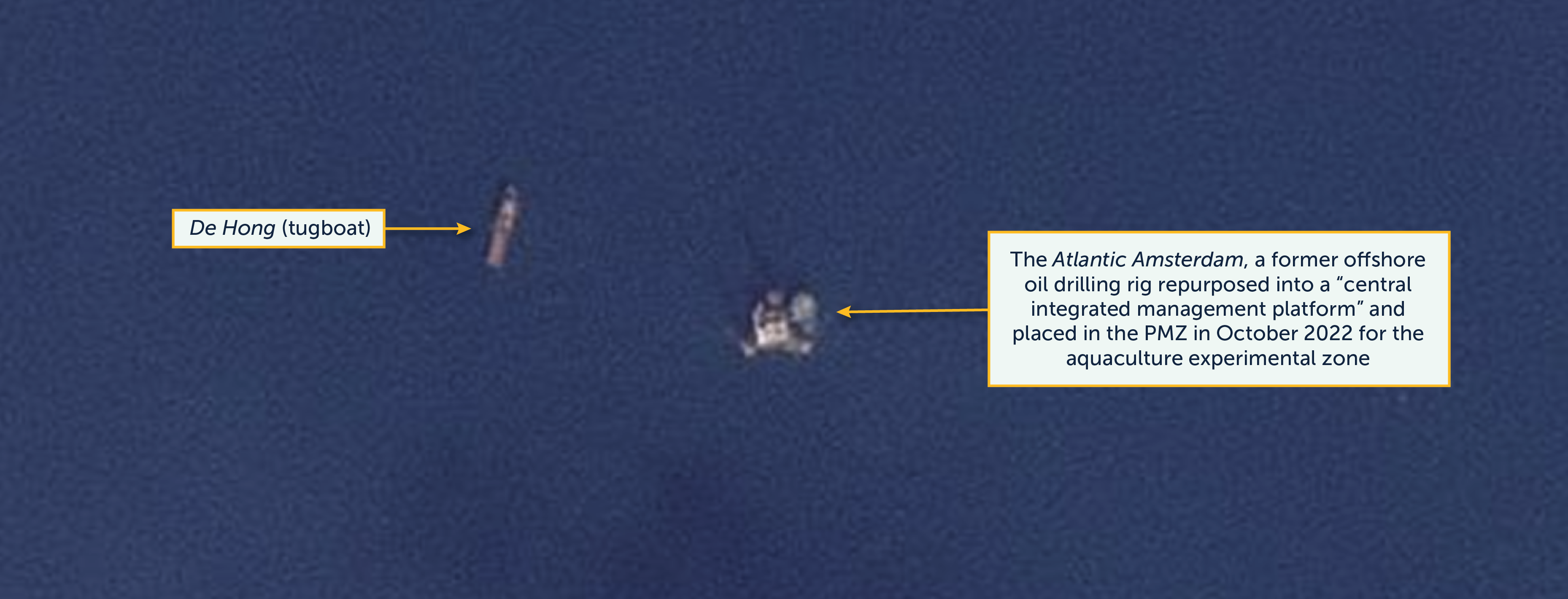
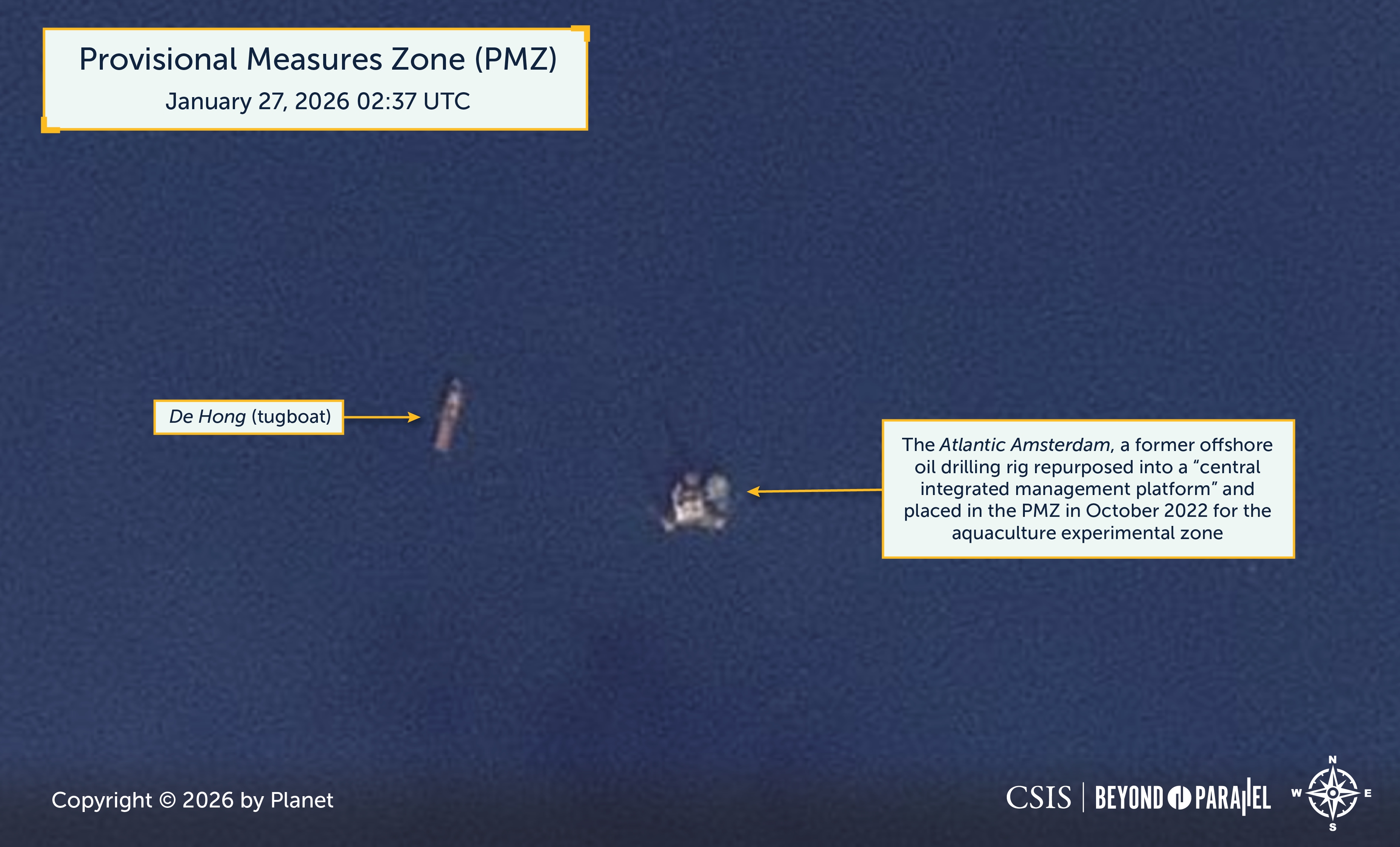
CSIS analysis of Automatic Identification System (AIS) data and satellite imagery corroborates these statements. Satellite imagery taken earlier, at 2:37 UTC (approximately 10:37 am China Standard Time and 11:37 am Korea Standard Time) on January 27 shows the Atlantic Amsterdam still at its original location inside the PMZ, where it had remained since October 2022.
Approximately eight hours later, at 10:30 UTC, AIS data indicate that the platform began moving, likely under tow by De Hong, a tugboat transmitting AIS signals immediately adjacent to the structure. The two vessels were also accompanied by another tugboat, the Weixiaotuo 1, and a China Coast Guard vessel broadcasting AIS under the name “Zhongguohaijian4073.”
Following the start of movement, AIS tracks show the Atlantic Amsterdam and accompanying vessels proceeding northward toward the PMZ boundary. As of 19:20 UTC, the platform was located approximately eight nautical miles (15 kilometers) south of the PMZ border, after which AIS transmissions from the platform and one supporting tugboat vessel ceased. As of 22:00 UTC, AIS data does not conclusively confirm that the Atlantic Amsterdam has exited the PMZ, but its last known position indicates that it was very close to doing so, if not already outside the zone.

The decision to relocate the Atlantic Amsterdam represents a significant step by China to address South Korea’s concerns, as the management platform is considered the most problematic of the three installations due to its operational role. Its movement out of the PMZ may help ease immediate tensions. However, it leaves questions for the two aquaculture cages, Shen Lan 1 and Shen Lan 2, and their support vessels, which remain in place and continue to operate in the PMZ. How China manages these remaining structures will shape whether the relocation of the Atlantic Amsterdam reflects a limited response to South Korea’s most pressing concerns or the beginning of a broader effort to promote stability in the area.
References
- Seo Ji-eun, “China begins relocating contentious maritime structure in disputed Yellow Sea zone,” Korea JoongAng Daily, January 27, 2026, https://koreajoongangdaily.joins.com/news/2026-01-27/national/diplomacy/China-begins-relocating-contentious-maritime-structure-in-disputed-Yellow-Sea-zone/2509962. ↩