Creeping Sovereignty? China’s Maritime Structures in the Yellow Sea (West Sea)
Under the 2001 Korea-China Fisheries Agreement, South Korea and China established a jointly managed maritime area called the Provisional Measures Zone (PMZ) in the Yellow Sea (West Sea). The agreement was the first fisheries agreement between the two countries and was designed to temporarily manage overlapping exclusive economic zone (EEZ) claims in the Yellow Sea.
The agreement created the following: 1) exclusive fishing zones for each country; 2) a jointly managed provisional measures zone (PMZ); 3) transitional zones with limited shared fishing; 4) a joint fisheries commission for coordination; and 5) enforcement rules. The agreement encourages transparency, rule-making, and mutual consultation in this shared maritime zone.
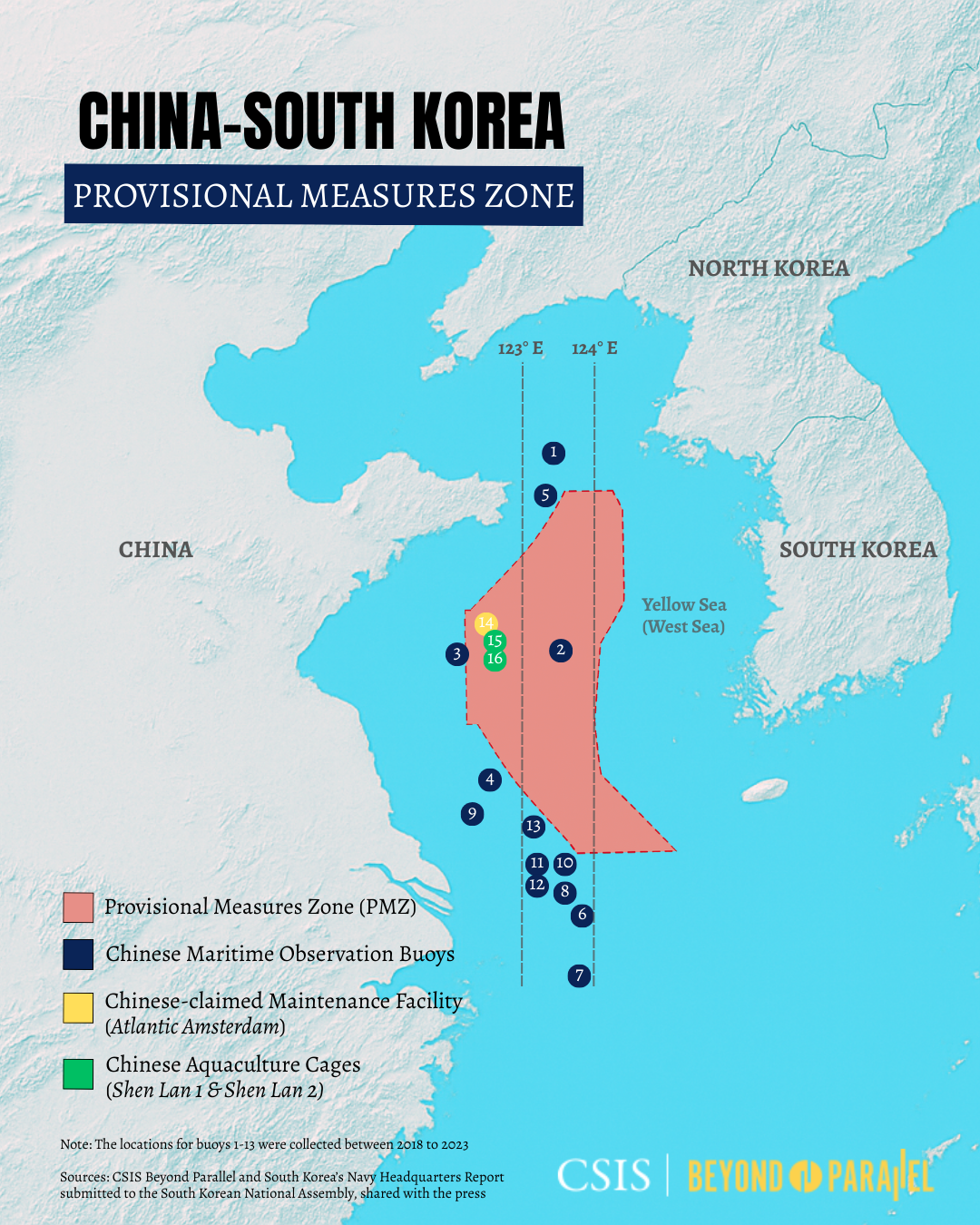
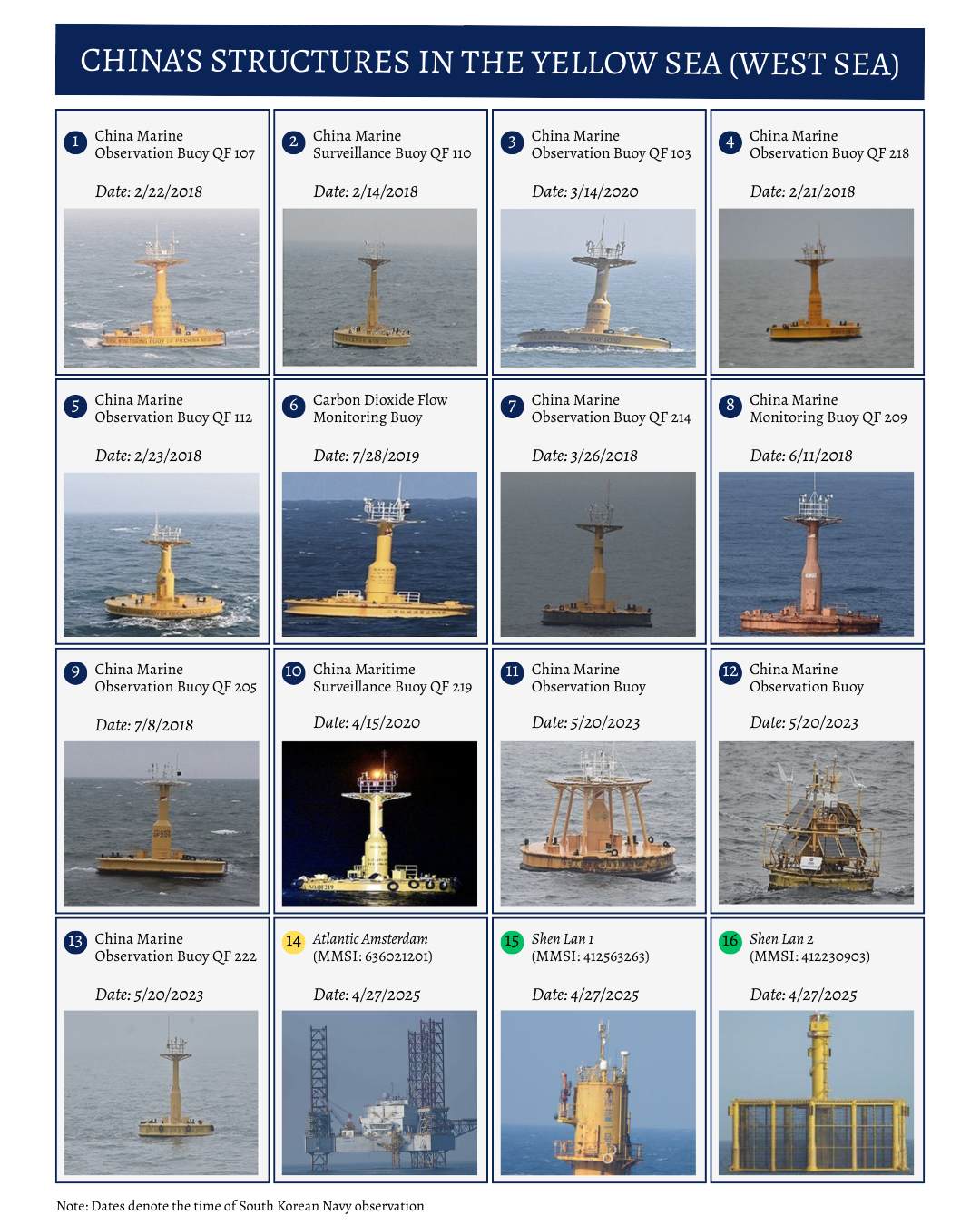
- Despite this agreement, since 2018, China has unilaterally deployed 13 buoys in and around the PMZ in the Yellow Sea. (see map below)
- China has also constructed two aquaculture cages ostensibly to breed fish, and an integrated management platform in the PMZ without prior consultation with South Korea.
- China’s placement of the Shen Lan 1, Shen Lan 2 and the Atlantic Amsterdam in the PMZ is a violation of the Korea-China Fisheries Agreement, which prohibits building permanent installations within the PMZ.
- China has not only repeatedly rejected South Korean requests to relocate the structures outside of the PMZ, but it has also unilaterally declared “no-sail” zones within the PMZ.
- Efforts by South Korean vessels to monitor Chinese activities have been intercepted by Chinese coast guard 27 times out of 135 attempts since 2020. This includes multiple instances of standoffs between the South Korean research vessel Onnuri and the Chinese coast guard this year.
- China’s use of its coast guard to patrol the perimeter of the PMZ and shadow Korean government and research vessels in the area is not a technical violation of the fisheries agreement or of UNCLOS.
- But these “civilian” installations for potential dual use purposes, and China’s harassment of South Korean vessels resemble “creeping sovereignty” grey zone tactics in the Yellow Sea that Beijing employed in the militarization of the South and East China Seas.
The accompanying map shows the approximate deployments of the Chinese maritime structures as well as photos of some of the structures and buoys. Accessing open-source data about the deployments is difficult given the sensitive nature of the issue for the two governments. However, South Korean government officials have expressed privately concerns about China’s “creeping sovereignty” tactics. For additional CSIS satellite imagery analysis of the permanent aquaculture platforms, see Chinese Platforms in the Yellow Sea’s South Korea-China PMZ.
Policy Recommendations
The United States should flag this activity as another example of China’s grey zone tactics targeting Indo-Pacific partners. Washington and Seoul should consider releasing the coordinates of the Chinese structures for public use and analysis. Washington should support any South Korean claims of unilateral violations of the PMZ agreement by China. In sum, what the new National Security Strategy mandates for the South China Sea is applicable to U.S. and South Korean efforts to maintain freedom of navigation in the Yellow Sea: “Strong measures must be developed along with the deterrence necessary to keep those lanes open, free of ‘tolls,’ and not subject to arbitrary closure by one country.”