
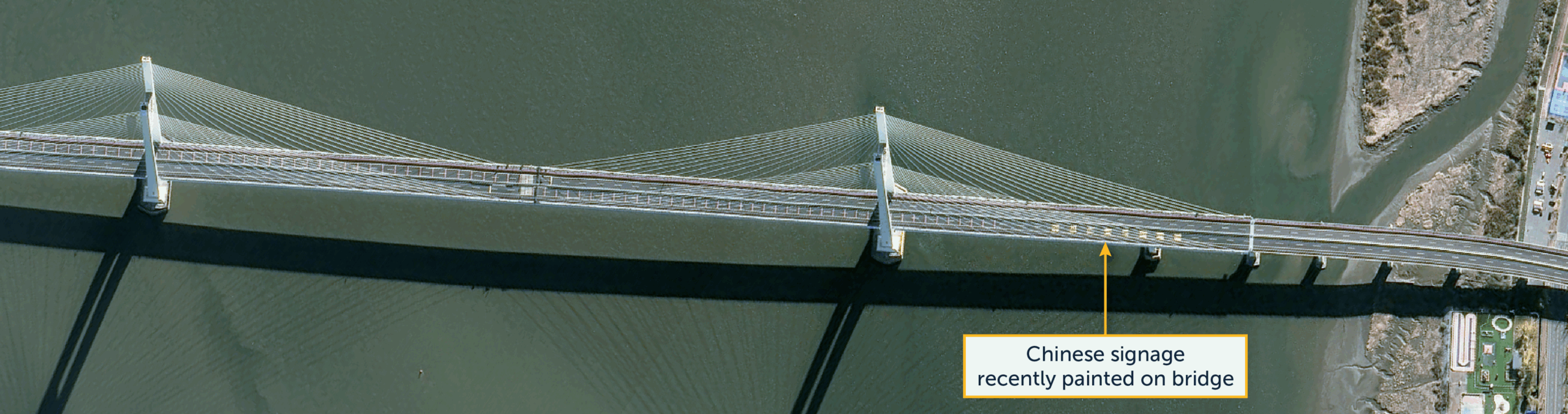
Progress at the Much-Delayed New Yalu River Bridge


Key Findings
- Recent satellite imagery shows that, although construction of the New Yalu River Bridge has been complete for several years, the bridge is still not operational due to North Korea’s failure to complete either its port-of-entry facility or the road connecting the bridge to the Sinuiju-Pyongyang highway.
- However, North Korea has made significant progress at the port-of-entry site this year, advancing at a faster rate than in previous years. Between January and November 2025, the site progressed from ground excavation to the construction of several facilities.
- North Korea’s failure to complete its construction responsibilities thus far was due to intermittent and sometimes long delays caused by financial constraints, construction resource constraints, and the COVID-19 crisis.
- It is unclear when the construction of the North Korean port-of-entry and associated road will be completed. If North Korea allocates sufficient resources to completing the port-of-entry, it could be finished and operational by the end of 2026. The same is true if China agrees to provide additional investment.
- When complete, the bridge will enable increased truck trade and tourist activity between the two nations, allowing the existing Sino-Korean Friendship Bridge to be dedicated primarily to rail traffic.
The New Yalu River Bridge (신압록강다리), also known as the Korea-China Amnok River Bridge (조중압록상다리), was first proposed by China’s then-Vice Minister of Foreign Affairs in 2007, and the deal was finalized during then-Chinese Premier Wen Jiabao’s visit to North Korea in October 2009.1 The formal agreement for the development occurred shortly after, in February 2010.2 The project was a strategic initiative to enhance cross-border connectivity between China and North Korea during a period of increasing diplomatic and economic engagement.
Construction of the bridge began in late 2011, with Chinese investment of 2.22 billion yuan. The bridge was slated to be built downstream and to replace the older Sino-Korean Friendship Bridge. By November 2011, according to Dandong officials, the main bridge structure was completed and was expected to become operational by July 2014.3 However, reports of delays due to North Korea’s failure to fulfill its contractual obligations for road construction began surfacing in 2014. By October 2014, the bridge opening was “postponed indefinitely, with Chinese media citing North Korea’s lack of construction progress being the reason for the suspension.4 According to an anonymous North Korean trade official, construction of the road connecting the bridge to Sinuiju resumed in 2018 after several years of delay but was again interrupted by COVID-19. Even after the road was completed in the fall of 2022, the customs clearance offices on the North Korean side remain unbuilt. In early October 2023, China agreed to provide the necessary investment to construct the North Korean customs facilities and finalize the bridge project.5

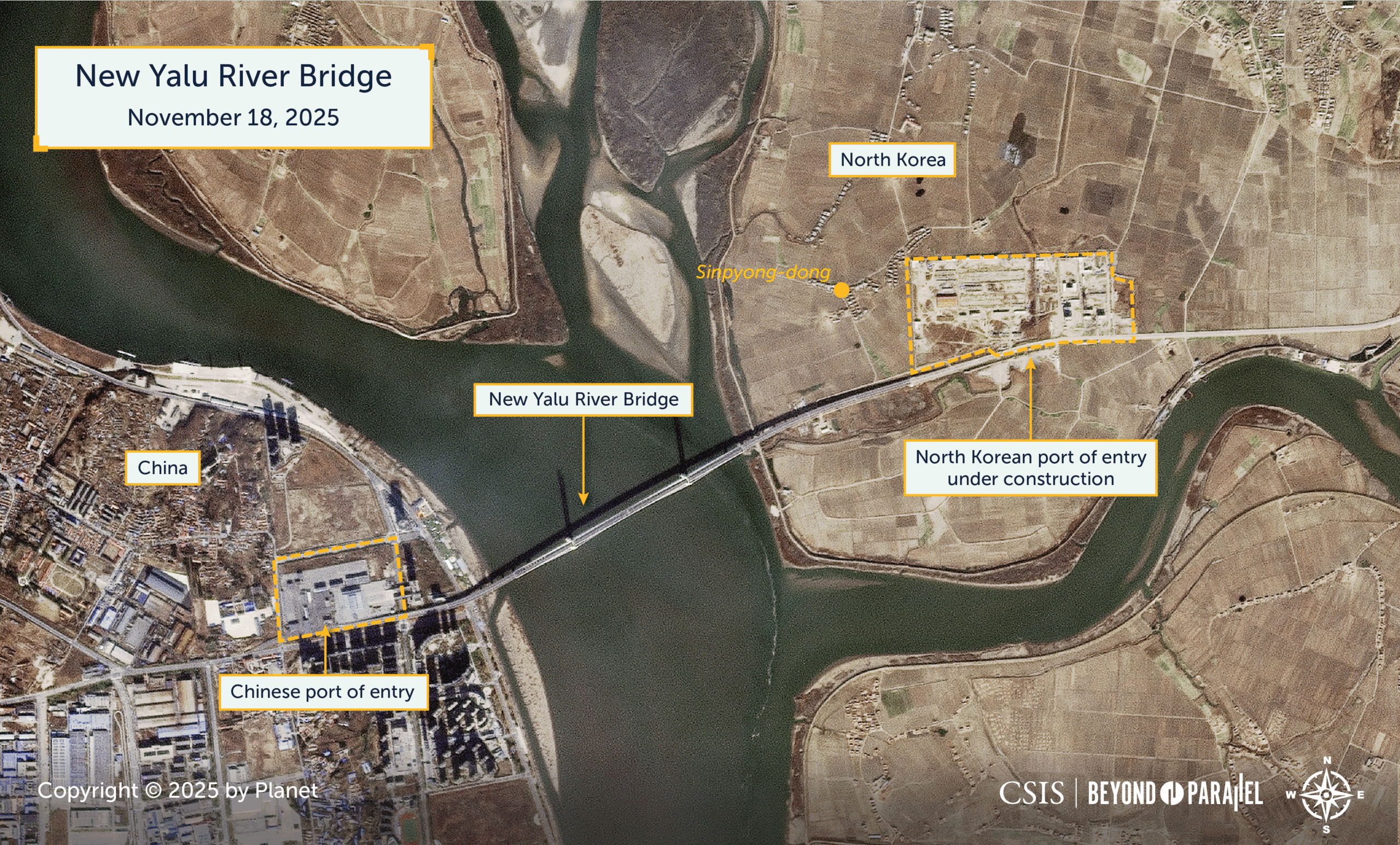
Satellite imagery and reporting during the past year show only occasional vehicles present at the Chinese port-of-entry facility.6 More notably, the North Korean port-of-entry facility has made significant construction progress this year, advancing at a faster rate than in previous years. Compared to a January 2025 image taken when excavation had just begun, a November 2025 image shows customs, immigration, security, and support facilities under construction. While the road leading from the North Korean port-of-entry facility to the primary Sinuiju-Pyongyang highway had been graded and the subbase and base laid, it has not received its final paving and markings. Neither of these two North Korean construction projects is complete.

The latest satellite imagery of the North Korean port-of-entry facility, adjacent to the small villages of Songso-ri and Sinpyong-dong, show the facility divided into two general areas. The first consists of warehouse, storage, and cargo transfer areas under construction. Chinese goods arriving here will likely be offloaded into warehouses, or Chinese drivers and cabs will be swapped for North Korean drivers and cabs, who will deliver the goods to their final destinations. The second area appears to consist of facilities for customs, immigration, and security under construction.
It is unclear when the construction of the North Korean port-of-entry and associated road will be completed. If North Korea allocates sufficient resources to completing the port-of-entry, it could be finished and operational by the end of 2026. The same is true if China agrees to provide additional investment as it did in 2023.
References
- “Chinese Government provides RMB 2.22 billion grant for New Yalu River Bridge Construction Project,” AIDDATA, 2023, https://china.aiddata.org/projects/67768/. ↩
- “China and North Korea sign agreement on the Yalu River border highway bridge,” Ministry of Foreign Affairs of the People’s Republic of China, February 25, 2010, https://www.mfa.gov.cn/web/zyxw/201002/t20100226_306749.shtml. ↩
- “Largest border city poised for trade boom,” China Daily, November 7, 2012, https://www.chinadaily.com.cn/m/liaoning/dandong/2012-11/07/content_15887471.htm. ↩
- “Report: China-North Korea bridge opening postponed indefinitely,” Hankyoreh, November 1, 2014, https://english.hani.co.kr/arti/english_edition/e_northkorea/662478.html. ↩
- Son Hyemin,“China agrees to finish bridge to North Korea,” Radio Free Asia, October 18, 2023, https://www.rfa.org/english/news/korea/bridge-10182023162623.html. ↩
- t is interesting to note that the Chinese port-of-entry is significantly smaller than that at the Wonjong-ni to Quanhe Border Crossing. See, Joseph S. Bermudez Jr., Victor Cha and Jennifer Jun. “Increase in Sino-North Korean Trade at Wonjong-ni-Quanhe Border Crossing,” Beyond Parallel, May 21, 2025, https://beyondparallel.csis.org/increase-in-sino-north-korean-trade-at-wonjong-ni-quanhe-border-crossing/. ↩