
Suspected Uranium Enrichment Building at Yongbyon Complete
Key Findings
- Satellite imagery from this month shows the completion of a building at Yongbyon that is widely believed to be a new uranium enrichment plant for producing weapons-grade material for nuclear weapons, according to the International Atomic Energy Agency (IAEA).
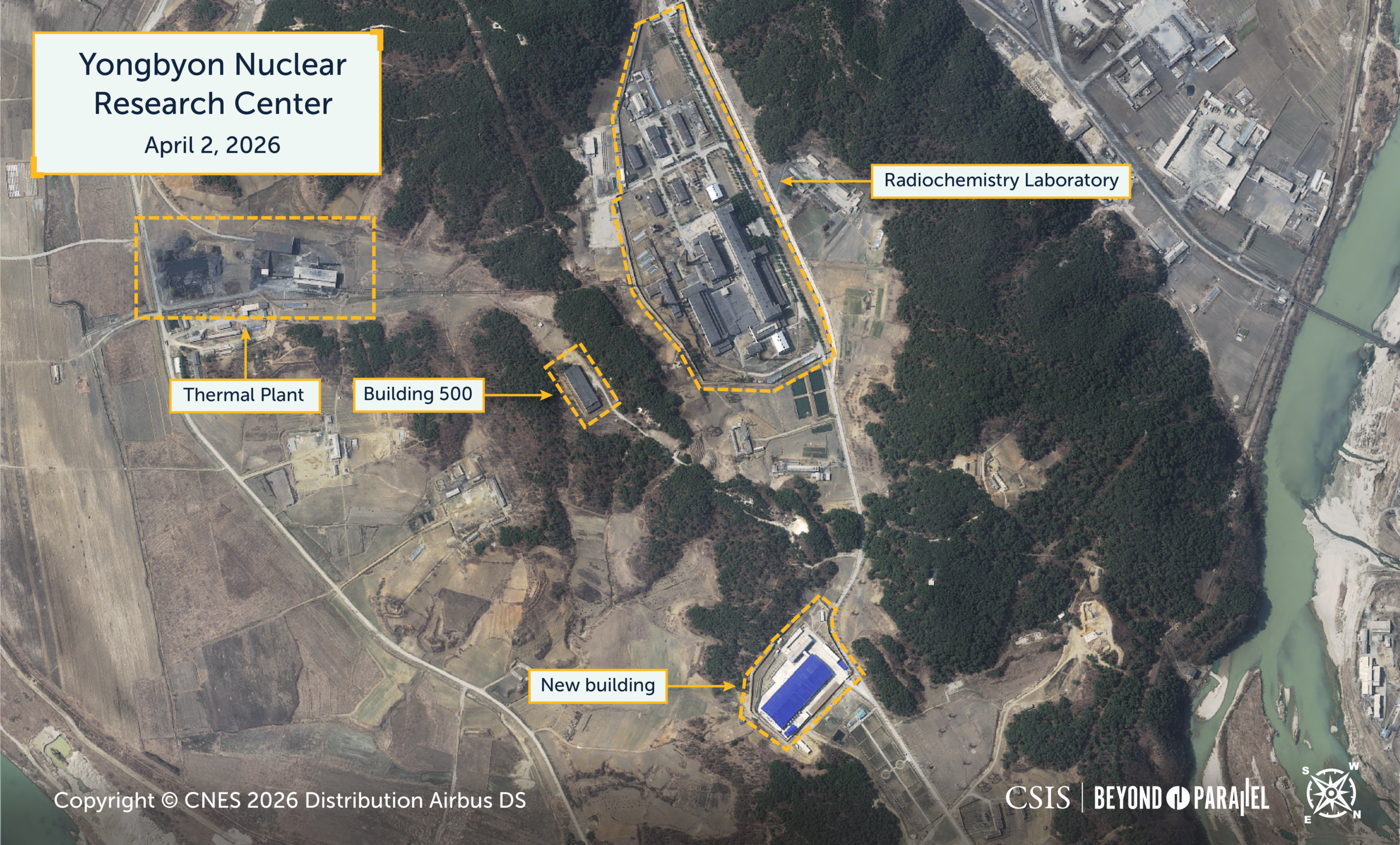
- The building, complete with generators, fuel storage tanks, cooling units and support buildings, is located 480 meters north-northeast of the Radiochemistry Laboratory and approximately 1,800 meters north of Yongbyon’s existing centrifuge halls.
- Satellite imagery analysis shows that construction of the new Yongbyon building began in mid-December 2024, was largely externally complete by early June 2025, and internal construction appears to be presently continuing.
- Any production of enriched uranium would significantly increase the number of nuclear weapons available.
As noted in Beyond Parallel’s 2025 report, on June 9, 2025, the International Atomic Energy Agency (IAEA) Director General Rafael Mariano Grossi stated that, “…the Agency is monitoring the construction of a new building at Yongbyon which has dimensions and features similar to the Kangson enrichment plant”.1 Almost a year later, on March 2, 2026, he again delivered a statement to the IAEA’s Board of Governors in which he briefly addressed North Korea’s nuclear program and the new building at the Yongbyon Nuclear Research Center:
“In addition, the Agency is continuing to monitor a new building at Yongbyon which has dimensions and infrastructure, including power supply and cooling capacity, similar to the Kangson enrichment facility. The new building is externally complete, and internal fitting is likely underway.”2
Four days later, on March 6, 2026, South Korean Unification Minister Chung Dong-young, while not specifically mentioning the new building, echoed similar concerns about North Korea’s nuclear program.3
None of these statements specifically confirms that the purpose of the new building is uranium enrichment. However, they are reasonable and clear indications of growing concerns about North Korea’s ongoing efforts to enrich uranium and potentially expand its nuclear weapons inventory, since both the new building (39.785074 125.758882) at Yongbyon and the Kangson facility (38.957175 125.611868) remain undeclared by North Korea.4
The ongoing review of available satellite imagery confirms Director Grossi’s statements that the new building, “…has dimensions and infrastructure, including power supply and cooling capacity, similar to the Kangson enrichment facility…[and] is externally complete, and internal fitting is likely underway.”
The location chosen for the new building was previously a small support compound approximately 480 meters north-northeast of the Radiochemistry Laboratory and approximately 1,800 meters north of Yongbyon’s existing centrifuge halls. Initial construction activity was first observed in mid-December 2024, when a series of large square holes was excavated on the east side of the support compound. These excavations were typical of those used for pouring concrete footings for large buildings. This was quickly followed by similar excavation within the center courtyard of the original support compound and the razing of all but two of the structures within the preexisting compound.


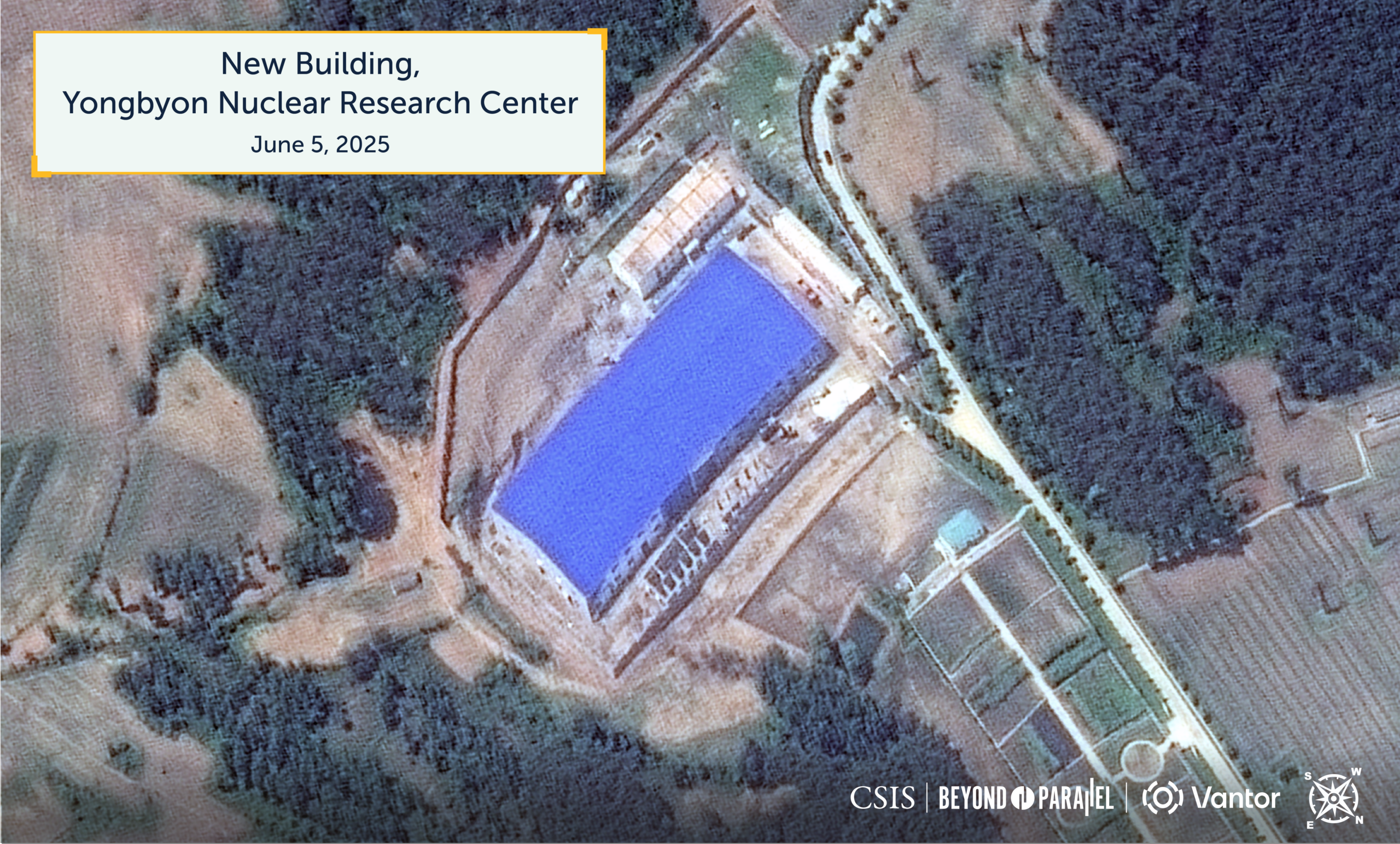

Images from 2024-2026 showing the development of the new building at Yongbyon. Image may not be republished without permission. Please contact imagery@csis.org.
Three months later, by April 2025, concrete footings had been poured, and a two-story steel-framed high-bay building with what appears to be a large central hall and a shallow-pitched blue roof was under construction. Concurrently, a security wall with what appears to be fencing on top of it was erected, encompassing the approximately 21,094-square-meter facility. By comparison, the Kangson facility (excluding housing and nearby support structures) encompasses approximately 18,940 square meters.
An image acquired on June 6, 2025, shows that the new building was largely externally complete and that internal construction continues, as is evidenced by supplies and equipment on the ground adjacent to the building. Additionally, two small fuel storage tanks had been installed on the south side of the new building, and construction of several new support buildings had begun.5 This new building measures approximately 120 by 48 meters (approximately 5,760 square meters), compared with the main building at Kangson, which externally measures approximately 115 by 52 meters (approximately 5,980 square meters).6
A more recent image, collected on April 2, 2026, shows the facility essentially complete, including a probable standby generator, administration/engineering support, and vehicle shed buildings. As well as several small support buildings. While the facility appears to have a standby generator building a line of electricity pylons coming from the north supplies day-to-day power. More than a dozen unidentified objects are present along the east side and northeast corner of the main building. These, along with the occasional presence of vehicles, groups of people (potentially workers), and other objects within the facility over the past four months, suggest that work to complete the main building’s interior is ongoing. Notably, this new facility does not have any of the monuments observed at Kangson or elsewhere within the Yongbyon Nuclear Research Center.

One of the obvious questions about this new building, especially if it is intended for uranium enrichment, is why North Korea built it near the Radiochemistry Laboratory. Most of North Korea’s current uranium enrichment capabilities are located approximately 2 kilometers to the south, centered on its existing centrifuge halls, making that area more suitable for such a new building. Regardless, Pyongyang has significantly augmented its weapons arsenal since Kim Jong-un came to power and his meeting with President Donald Trump in 2019. In March 2026, the South Korean Unification Minister Chung Dong-young estimated that “North Korea may have extracted around 100 kilograms of plutonium over the past 30 years, including 16 kg last year, an amount capable of producing some 20 nuclear weapons.” Any production of enriched uranium would significantly increase the number of nuclear weapons available.
References
- “IAEA Director General’s Introductory Statement to the Board of Governors,” IAEA, 9 June 2025, https://www.iaea.org/newscenter/statements/iaea-director-generals-introductory-statement-to-the-board-of-governors-9-june-2025. ↩
- “IAEA Director General’s Introductory Statement to the Board of Governors,” IAEA, 2 March 2026, https://www.iaea.org/newscenter/statements/iaea-director-generals-introductory-statement-to-the-board-of-governors-2-6-march-2026. ↩
- “Unification minister points to N. Korea’s Kusong as 3rd site hosting uranium enrichment facility,” Yonhap, March 6, 2026, https://m.koreaherald.com/article/10688947. ↩
- Ibid.: As with the 1999 inspection of the suspected Kumch’ang-ni facility demonstrates it is essential to be cautious of declaring any North Korean facility as being nuclear related without independent outside on-the-ground inspection. Regarding the Kumch’ang-ni facility see, Dana Priest, “U.S. Warns N. Korea on Nuclear Facility,” Washington Post, August 26, 1998, and Joseph S. Bermudez Jr., “Exposing North Korea’s Secret Nuclear Infrastructure – Part One,” Janes Intelligence Review, Vol. 11, No, 7, July 1999, pp. 36-41. ↩
- Jeffrey Lewis, Sam Lair, David Albright, Sarah Burkhard, and Spencer Faragasso have provided excellent discussions concerning this new facility. Jeffrey Lewis and Sam Lair provide a comparison between the new building at Yongbyon with the buildings at Kangson and at Pakistan’s Kahuta Uranium Enrichment Facility. Jeffrey Lewis and Sam Lair, “A New Enrichment Plant at Yongbyon?,” Arms Control Wonk. David Albright, Sarah Burkhard, Spencer Faragasso provide an excellent discussion concerning the new facility. “Is North Korea Building a New, Kangsong-Like Building at Yongbyon?,” Institute for Science and International Security, June 11, 2025, https://isis-online.org/isis-reports/detail/is-north-korea-building-a-new-kangsong-like-building-at-yongbyon. https://www.armscontrolwonk.com/archive/1220487/a-new-enrichment-plant-at-yongbyon/. David Albright, Sarah Burkhard, and Spencer Faragasso, “Is North Korea Building a New, Kangsong-Like Building at Yongbyon?,” Institute for Science and International Security, June 11, 2025, https://isis-online.org/isis-reports/detail/is-north-korea-building-a-new-kangsong-like-building-at-yongbyon., and Sarah Burkhard, Jocelyn Bridges, and the Good ISIS Team. “Imagery Update of Activities at North Korea’s Yongbyon Site,” Institute for Science and International Security, December 19, 2025, https://isis-online.org/isis-reports/imagery-update-of-activities-at-north-koreas-yongbyon-site. ↩
- The measurements present here should be considered as approximations until higher commercial satellite imagery becomes available. ↩