December 11, 2019, by Joseph S. Bermudez Jr. and Victor Cha—
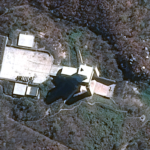
On December 7, North Korea conducted what it described as a “…very important test at the Sohae Satellite Launching Ground.” Satellite imagery in the days leading up to and after the test clearly shows that this was a rocket engine test at the vertical engine test stand at Sohae. This test was most probably of a liquid-fuel rocket engine as only liquid-fuel rocket engines have previously been tested here, while large solid rocket motors have been tested at the Magunpo Solid Rocket Motor Test Facility on the east coast and elsewhere. Whether the liquid-fuel rocket engine was an existing model or a new one is unknown.
December 4, 2019, by Joseph S. Bermudez Jr. and Victor Cha—
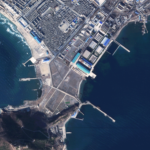
There is no evidence that the “newly built submarine” inspected by Kim Jong-un on July 23, 2019 has been launched. While many media sources have described this new submarine as an imminent threat, it is more accurate to describe it as an emerging threat. The large canopy constructed during late-August and early-September that conceals much of the submarine dock precludes confirmation that the existing SINPO-class experimental ballistic missile submarine (SSBA) is present.
November 26, 2019, by Victor Cha, Eric Falcon and Bryce Pedersen—
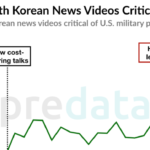
Predata signals suggest a significant perception gap emerging between the U.S. and South Korea. First, South Koreans are more focused on the financial burden of the U.S. military presence than on the positive security benefits it provides. Second, U.S. demands for $5 billion in cost-sharing are generating the highest ever levels of social media and video commentary critical of U.S. forces in Korea.
November 22, 2019, by Victor Cha and Richard Armitage—
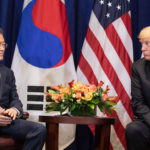
The 66-year alliance between the United States and the Republic of Korea is in deep trouble. The U.S.-China trade war, the South Korean government’s quiet leaning toward Beijing and President Trump’s transactional view of alliances have created a unique constellation of forces. The result could be a premature withdrawal of U.S. troops from the peninsula at a time when North Korea’s nuclear threat and China’s regional dominance grow unabated.
November 19, 2019, by Joseph S. Bermudez Jr. and Marie DuMond—
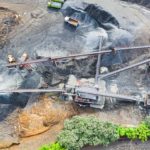
Antiquated facilities, equipment, and processes, together with the continual plague of electricity shortages, will hinder any dramatic production increases of magnesite at North Korea's Taehung Youth Hero Mine... The Taehung Youth Hero Mine "has established the Juche orientation in the production of fireproof…
November 14, 2019, by Joseph S. Bermudez Jr., Victor Cha and Dana Kim—
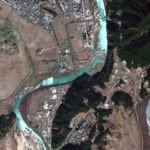
Recent satellite imagery from November 2019 shows the presence of four specialized railcars that have been associated with the movement of radioactive material in the past. The last observed movement of these railcars by Beyond Parallel was in April 2019. It is unclear whether the railcars are being used for the outbound shipment of irradiated liquid or solid waste, disassembled but contaminated equipment or the movement of fissile material to facilities outside the Yongbyon area. A less likely alternative is the inbound shipment of radioactive material from a facility outside the Yongbyon area.
November 14, 2019—
This bonus episode comes from CSIS's Beyond Parallel Living History video series. We invite former South Korean Minister of Foreign Affairs and Trade Song Min-soon to discuss global efforts to denuclearize North Korea during the six-party talks. Minister Song was the director general for North American affairs and chief delegate during the six-party talks in 2005. He played a key role in the September 2005 multilateral denuclearization agreement with North Korea, involving the U.S., Japan, South Korea, China and Russia.
November 13, 2019—
This Living History interview features former South Korean minister of foreign affairs and trade, Song Min-soon. Song was director general for North American affairs and chief delegate during the six-party talks in 2005. He played a key role in the multilateral denuclearization agreement with North Korea, involving the United States, Japan, South Korea, China, and Russia, achieved in September 2005.
November 1, 2019, by Sue Mi Terry—
For Halloween, Kim Jong Un gave Donald Trump a trick, not a treat: North Korea fired two short-range missiles on Thursday toward the Sea of Japan. It was North Korea’s 13th weapons test this year—and the first since the Trump administration’s latest attempt to restart negotiations with North Korea quietly failed a few weeks ago. The first talks between the two sides in eight months broke down after only 8½ hours in Stockholm. The North Korean delegates stalked out, and Pyongyang subsequently said they wouldn’t resume the “sickening” negotiations with the U.S.
November 1, 2019—
In this episode, Andrew talks with resident North Korea expert Victor Cha, and Dr. Kang Choi, acting president of the Asan Institute for Policy Studies. They discuss North Korea’s recent missile launch, South Korea-Japan relations, and more... In this episode, Andrew talks with resident North Korea expert Victor Cha, and Dr. Kang…