
After Iran: A Scenario for Renewed Trump-Kim Summitry
This originally was published on CSIS.org as a Critical Questions here.
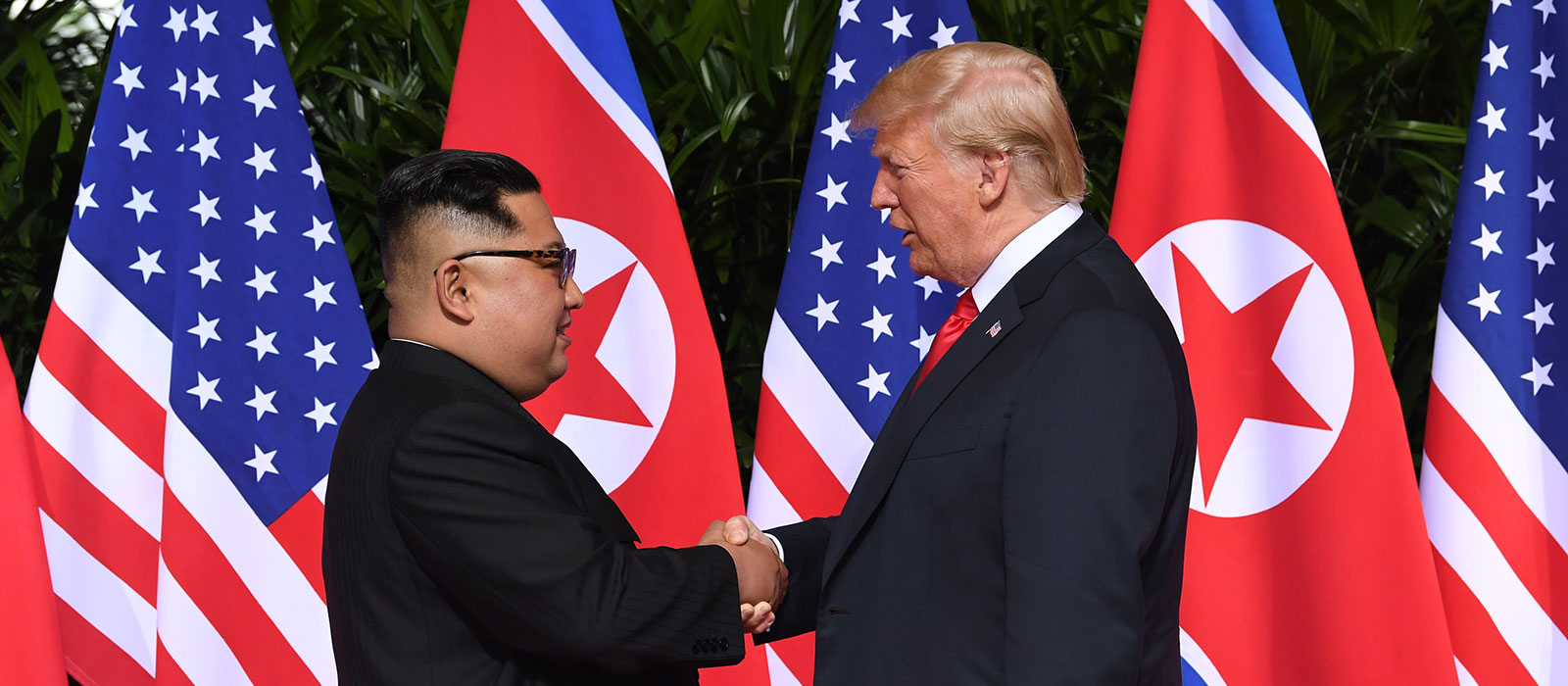
U.S. President Donald Trump reportedly told South Korean President Lee Jae Myung on the sidelines of the June 2026 G7 meetings in France that he would restart diplomacy with North Korea. As if to accentuate the point, he later posted a picture on social media of his stroll with Kim Jong-un at the Capella Hotel in Singapore. During Trump’s first term, he met with Kim three times in 2018 and 2019—in Singapore, Vietnam, and Panmunjom, within the Korean demilitarized zone—which produced one joint statement about peace and denuclearization on the Korean peninsula. The conventional policy wisdom is that Trump’s enthusiasm for reengagement is not shared by the North Korean leader. But a unique set of drivers could spur a renewal of diplomacy.
Q1: Why would the North Korean leader be interested in more summits with Trump?
A1: The main driver relates to the extent to which Kim Jong-un is revisionist, and not status-quo oriented. If he is revisionist in his outlook, he would look to capitalize on any available opportunity to advance the core goal of cementing his status as a nuclear weapons state. Most experts believe the failed summitry of Trump’s first term—ending with the U.S. president walking out of meetings in Hanoi—left Kim not only embarrassed but deterred from future encounters with the unpredictable Trump. Moreover, North Korea’s pursuit of sanctions relief during the last round of summitry in 2018–2019 appears less of a motivation today for Pyongyang now that Russia has undermined the UN Security Council sanctions regime against North Korea by vetoing renewal of UNSCR 1874, which established the Panel of Experts monitoring organ for sanctions compliance. Any support from Moscow for UN sanctions has been replaced by North Korea’s provision of billions of dollars in bountiful trade and military assistance for Vladimir Putin’s war against Ukraine, stemming from Kim’s supply of munitions, troops, missiles, and laborers. China has also greatly ratcheted down compliance with sanctions, boosted trade to pre-pandemic levels, and at the June 2026 summit with Kim, committed to expand cooperation across infrastructure, tourism, agriculture, and health. With all that Kim is getting from Putin and Xi Jinping, the risks associated with another meeting with Trump appear unattractive, pundits argue.
What is missed in this conventional analysis is whether revisionism, rather than the status quo, drives Pyongyang’s foreign policy mindset. There is reason to believe it might, as was evident, for example, when North Korea emerged from the Covid-19 pandemic. Many believed that the leadership would remain focused on recovering and renewing trade with China after a three-and-a-half-year lockdown that devastated its economy. Instead, Kim saw an opportunity with Russia’s need for ammunition and troops in the Ukraine war and proposed to Putin a military partnership that eventually led to billions in revenue and a new mutual defense treaty.
In a similar vein, Kim may see opportunities in reengaging with Trump. Aside from the U.S. president’s expressed desires to meet, North Korea surmises that Trump’s commitment to denuclearization as the premise of any negotiation is malleable at best as the president alternates between supporting such a goal and admitting that North Korea is a “nuclear power.” Moreover, Pyongyang has learned from the Iran deal that the United States now operates in a “post-diplomacy” world where the primary deliverables take the form of grand but vaguely worded statements, coupled with the promise of follow-on negotiations without any real prospect of agreements. The other lesson from Iran for North Korea is that maintaining contact may be the best way to manage Trump’s unpredictability and penchant to use military force.
If revisionist, Kim may target a meeting with Trump, potentially after a U.S. midterm election loss for the party in power, to reaffirm the basic tenets of the Singapore Declaration from their first meeting in 2018. They would likely avoid detailed denuclearization negotiations, leaving it to their teams to hash out over the next six months. Instead, Kim might push the conversation toward peace treaties, stopping U.S. military exercises, and ending the hostile state of relations between the United States and North Korea, appealing to Trump’s resume-building for the Nobel Peace Prize. These tangible outcomes might seem modest, but they would be significant to the North Korean perennial goal of achieving de facto U.S. acceptance of the country as a nuclear weapons state.
Q2: Would that be enough for North Korea?
A2: No. If revisionism truly drives Pyongyang’s mindset, it might also spur additional ambitions to reengage with Japan. North Koreans see Prime Minister Sanae Takaichi as a political maverick unafraid to do the unconventional, a defense hawk, and a beneficiary of strong public support. The best chance for engagement is with someone of Takaichi’s ilk—a hawkish, not dovish, leader, creating a potential “only Nixon can go to China” opportunity. North Koreans have told the author of their disdain for the late Prime Minister Shinzo Abe, Takaichi’s mentor, because of his supporting role in former Prime Minister Junichiro Koizumi’s diplomacy with Kim Jong-il in 2002, only to turn hardline during his premiership. In this sense, Takaichi represents a clean break, even as her ties to Abe would protect her right flank domestically if she were to engage with North Korea. Japan has quietly moved away from its longstanding position of resolution of the abductions issue (kidnapping of, and accounting for Japanese citizens in the 1970s) as a precondition for talks.
Kim could seek a meeting with Takaichi to reaffirm the basic tenets of the 2002 Pyongyang Declaration, which could potentially bring billions of dollars into a normalization settlement. On this and the abductions issue, they could authorize negotiation teams to work out the details. Pyongyang’s goal for such diplomacy is to achieve a position where the North Korean leader would have summits with both the United States and Japan—a feat not accomplished by any previous leader—as a nuclear weapons state, while dividing U.S.-Japan-South Korea trilateral cooperation (see below). What drives Pyongyang, however, may not drive Tokyo. Takaichi may justifiably see too much risk in such diplomacy. But she may also see opportunity in trying to reduce the threat of North Korean short-range missiles aimed at Japan when Trump cares only about long-range ballistic missiles targeted at the United States.
Q3: Would this spur opportunities for inter-Korean engagement?
A3: In this revisionist mindset, North Korea would not seek to engage South Korea as part of its diplomatic outreach. In 2024, North Korea swore off any further dialogue with the South. Rather than engage in peaceful coexistence as the Lee government has proposed, a revisionist diplomatic strategy that engages Washington and Tokyo while bypassing Seoul would be most attractive. It could divide the allies and isolate its southern rival, not unlike what South Korea did to North Korea in the 1990s at the end of the Cold War when it succeeded in establishing relations with Moscow and Beijing.
Q4: Wouldn’t China oppose North Korean contacts with the United States?
A4: Under normal circumstances, China would not support U.S.-North Korea diplomacy. But for Beijing, today’s circumstances are far from normal. The main driver for China in this scenario is whether Beijing wants to hedge against both Trump’s unpredictability and Putin’s ties to Kim.
Beijing usually has trepidations about U.S.-North Korea contacts that might harm its equities on the peninsula. Prior to Trump’s first meeting with Kim in 2018, Xi Jinping held no meetings with Kim Jong-un, confident in China’s influence over its smaller communist brethren. But once Trump’s diplomacy started, Xi met five times with Kim to protect Chinese interests. This applies not just to the United States. After Trump’s diplomacy with Kim failed, Xi stopped meeting Kim from 2019 to 2025; however, once summitry started between North Korea and Russia about cooperation in the Ukraine war, Xi met with Kim two times, including Xi’s only overseas trip thus far in 2026 to Pyongyang in June.
Given the current constellations of geopolitical forces, however, China could promote a renewal of Trump-Kim diplomacy. This is largely because Beijing may want to ingratiate itself with Trump, but also subtly dilute Russia’s growing influence over North Korea. China experts have told the author that Beijing is not supportive of the trajectory of Moscow-Pyongyang cooperation, but that any direct intervention could sour China’s relations with both. Helping Trump meet Kim may be a more subtle way of achieving this goal. Media reporting coming out of the Trump-Xi summit suggests that the two leaders spent time discussing North Korea. It would not be surprising if during Xi’s follow-on trip to Pyongyang, China conveyed a message of support for U.S.-North Korea diplomatic reengagement.
Should such geopolitical machinations come to fruition, they would generate flashy news headlines and achieve a superficial reduction in tensions, but none would address the fundamental issues of denuclearization or peace. But in a “post-diplomacy” world, this may be the best we can hope for.
Victor Cha is president of the Geopolitics and Foreign Policy Department and Korea Chair at the Center for Strategic and International Studies in Washington, D.C
Critical Questions is produced by the Center for Strategic and International Studies (CSIS), a private, tax-exempt institution focusing on international public policy issues. Its research is nonpartisan and nonproprietary. CSIS does not take specific policy positions. Accordingly, all views, positions, and conclusions expressed in this publication should be understood to be solely those of the author(s).
© 2026 by the Center for Strategic and International Studies. All rights reserved.